A customer searches for your business before making a decision. They might read a Google review, compare comments on social media, explore a discussion forum, or look for feedback from previous customers. What they discover can influence whether they contact your company, visit your location, or choose a competitor instead.
The challenge is that your online reputation develops across multiple platforms, and not every mention appears where you normally look. A new review can go unnoticed, a customer complaint can attract attention, or outdated business information can create confusion. Without a consistent monitoring process, businesses may discover these issues only after they have affected customer trust.
Online reputation monitoring helps businesses identify reviews, brand mentions, customer feedback, and emerging concerns across relevant online channels. It gives business owners a clearer picture of how their brand is being discussed and helps them decide when further investigation or action is necessary.
For businesses that want to understand their online presence, monitoring is an important part of a broader reputation management strategy. An Online Reputation Management Company can help businesses track customer reviews, monitor brand mentions, and identify changes in public perception. American Digital Agency helps USA businesses strengthen their online visibility and understand the reputation signals that influence customer trust.
What Is Online Reputation Monitoring?
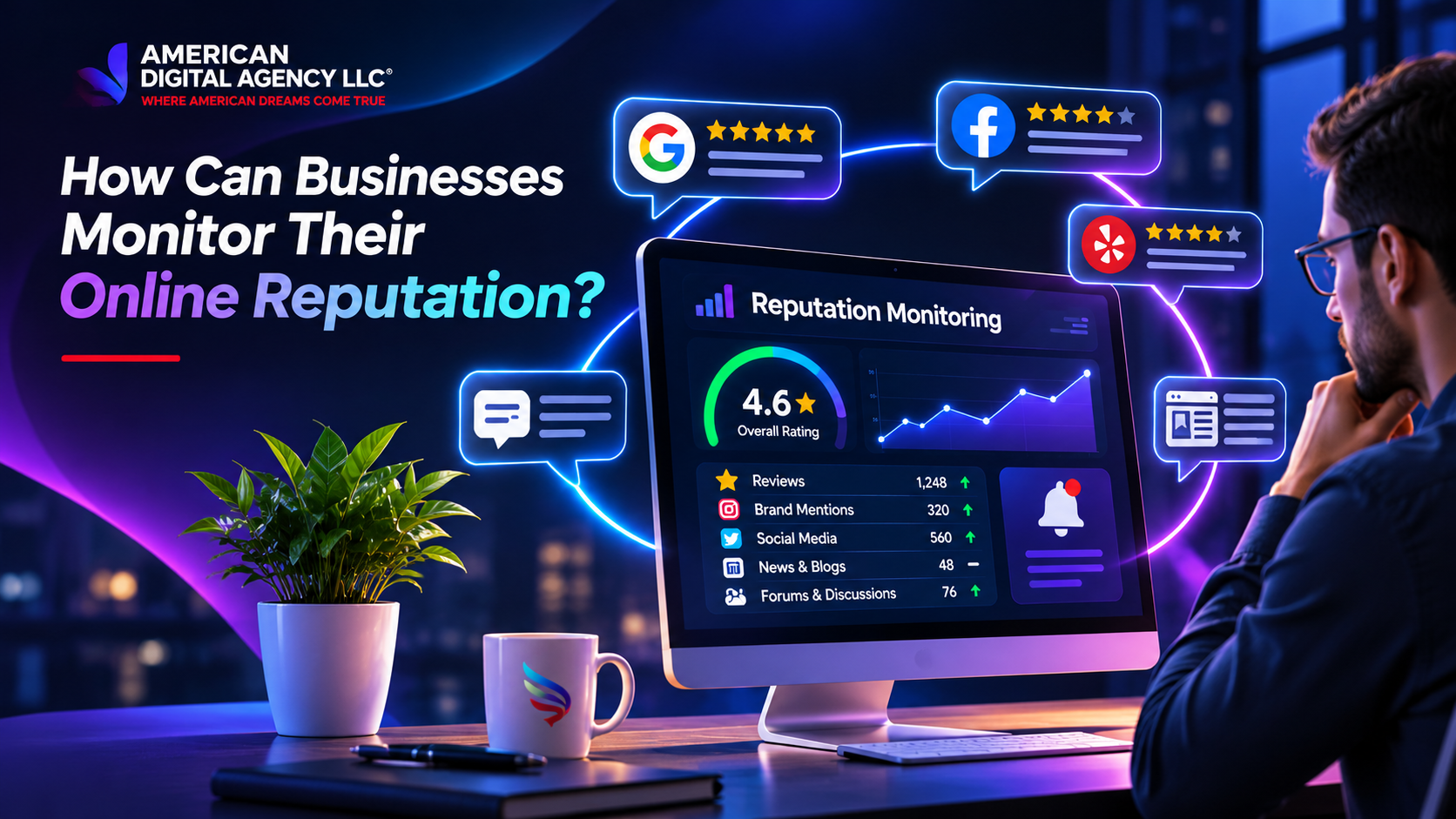
Online reputation monitoring is the process of tracking how a business appears and is discussed across digital platforms. This can include customer reviews, social media mentions, search results, news coverage, industry websites, and public discussions relevant to a brand.
The purpose is to identify information that may influence how people perceive a company. Monitoring can reveal positive feedback, recurring customer concerns, incorrect business information, or sudden changes in the volume of public discussion.
It is different from reputation recovery. Monitoring focuses on detecting and understanding what is happening, while recovery involves taking steps to address an existing reputation problem. Similarly, review management may involve responding to customer feedback, whereas monitoring helps ensure that feedback is identified and evaluated in the first place.
A well-organized monitoring process makes these activities easier to coordinate. Instead of relying on occasional searches or checking platforms only when a customer raises a concern, businesses can establish a consistent way to track relevant changes.
Why Should Businesses Monitor Their Online Reputation?
Customers increasingly use online information to evaluate businesses before contacting them. Reviews, ratings, public comments, and brand mentions can provide clues about service quality, reliability, and customer experience.
When businesses monitor these signals regularly, they can identify patterns that might otherwise remain hidden. For example, several customers mentioning delayed appointments may indicate an operational issue. Repeated questions about an unclear service offering may suggest that website content needs improvement. A sudden increase in negative comments may require closer investigation to understand whether the issue is isolated or widespread.
Monitoring also helps businesses recognize positive signals. Customers may repeatedly praise a particular service, employee, or aspect of the buying experience. These patterns can help teams understand what customers value and where the business is performing well.
The goal is not to control every conversation or prevent all criticism. It is to understand what people are saying, identify relevant changes, and use that information to make informed decisions about customer experience and brand communication.
How Can Businesses Monitor Customer Reviews?
Customer reviews are one of the most direct sources of public feedback. Depending on the business, important review platforms may include Google, Yelp, industry-specific directories, and websites where customers compare providers.
Businesses should begin by identifying the platforms their customers actually use. A local service provider may prioritize Google Business Profile and relevant local directories, while a professional services company may also need to monitor industry-specific review websites.
The next step is to establish a regular review-checking process. Teams should track new reviews, changes in ratings, recurring complaints, and unusual increases in review activity. They should also verify that the business name, contact details, location information, and service descriptions remain accurate on important listings.
Google Business Profile allows businesses to manage notifications about customer activity, including new reviews and photos. Available notifications can be adjusted through the profile settings.
However, platform notifications should not be treated as a complete monitoring system. Different websites have different features, and one platform’s alerts will not automatically cover every other source where a company may be discussed.
How Does Brand Mentions Monitoring Work?
Brand mentions monitoring involves tracking references to a business across online sources, including places where the company has not been directly tagged or contacted.
These mentions may appear in social media posts, blogs, forums, news articles, industry publications, or public discussions. Some references are positive, while others may contain questions, criticism, inaccurate information, or comparisons with competitors.
A practical starting point is to identify the terms associated with the business. These may include its exact brand name, common variations, product names, important service names, and the names of public-facing representatives when relevant. Businesses should also consider common spelling mistakes that could cause mentions to be missed.
Search engines can help identify publicly indexed references, while suitable monitoring platforms may offer broader discovery or alerting features. The available coverage depends on the source, platform permissions, and the capabilities of the chosen tool.
Brand mentions monitoring should prioritize relevance rather than collecting every possible reference. A passing mention with no connection to the company’s services may need no action, while a detailed customer complaint or an article containing incorrect business information may deserve immediate review.
How Can Businesses Use Brand Reputation Monitoring Tools?
Brand reputation monitoring tools can help organize information that would otherwise require repeated manual searches. Depending on the product, features may include keyword tracking, review alerts, mention discovery, sentiment categorization, dashboards, reporting, and team notifications.
Before choosing a tool, businesses should evaluate the specific features they need. A small local company may primarily need notifications for new reviews and a straightforward tracking spreadsheet. A business operating across multiple locations may benefit from centralized reporting, location-level comparisons, and more advanced alert workflows.
Tool evaluation should include the platforms covered, the frequency of updates, alert delivery methods, historical data availability, reporting options, and the ability to distinguish relevant mentions from unrelated results. Businesses should also confirm whether a feature is included in their selected plan and whether the service can access the sources that matter to them.
Google Business Profile provides a starting point for monitoring activity on a company’s own Google listing. For more technical requirements, Google’s Business Profile Notifications API supports notifications about events such as new or updated reviews and business information changes. Setting up API-based notifications requires technical configuration, including Google Cloud Pub/Sub, and is not the same as enabling standard profile notifications.
No single tool should be assumed to capture every online conversation. The best setup is one that matches the company’s platforms, staffing, response requirements, and reporting needs.
How Can Business Review Alerts Improve Monitoring?
Business review alerts help teams identify new customer feedback without relying entirely on manual checks. When a platform offers suitable notifications, businesses can receive updates when new reviews or other relevant activity appears.
The value of an alert depends on what happens after it arrives. A notification that sits unread in an inbox does little to help the business understand the situation. Effective monitoring requires someone to review the feedback, assess its relevance, record any important details, and decide whether follow-up is necessary.
Businesses can organize alerts according to urgency. A routine positive review may simply need to be recorded, while an allegation involving customer safety, privacy, fraud, or serious service failure may require prompt escalation to an appropriate manager. A sudden increase in reviews or repeated complaints about the same issue may also warrant investigation.
Alerts should be configured around meaningful business risks rather than every possible notification. Too many irrelevant alerts can overwhelm staff and make genuinely important issues easier to miss. A clear process helps the team distinguish routine activity from events that require attention.
How Can Businesses Identify Customer Feedback Trends?
Individual reviews provide useful details, but patterns across multiple reviews can reveal broader issues. Customer-feedback trend analysis involves grouping comments by recurring themes, such as product quality, communication, appointment availability, delivery, pricing clarity, or customer support.
For example, one complaint about a delayed response may be an isolated experience. If similar complaints continue appearing over several weeks, the pattern may indicate a problem with the company’s support process. Likewise, repeated praise for knowledgeable staff may reveal a strength worth maintaining.
Businesses can track the number of reviews received, changes in average ratings, recurring positive and negative themes, and the frequency of mentions related to specific services. Comparing these indicators over consistent periods can help teams understand whether customer perceptions are changing.
Context matters when interpreting the data. A business that receives more customers may also receive more reviews and complaints in absolute numbers. A sudden change in feedback should therefore be assessed alongside business activity, the nature of the comments, and the platforms involved.
Automated sentiment analysis can help organize large amounts of feedback, but it may misunderstand sarcasm, context, or industry-specific language. Human review remains important when the meaning of a comment could affect a business decision.
How Should Businesses Create an Online Reputation Monitoring Workflow?
An effective workflow turns monitoring into a repeatable business activity rather than an occasional task. The process begins by identifying priority platforms, brand terms, service names, and the types of feedback that matter most.
Next, businesses should establish how information will be collected. This might involve native platform notifications, selected monitoring tools, scheduled searches, or a combination of these methods. Each source should have a clear owner responsible for checking the information and recording relevant findings.
The team should then define escalation criteria. A routine review may require no further action beyond recording it, while repeated complaints, suspicious review activity, inaccurate public information, or a rapidly spreading allegation may need management attention. Sensitive matters should be referred to the appropriate legal, privacy, security, or customer-service personnel when necessary.
Finally, monitoring results should be reviewed regularly. Teams can assess whether important mentions were detected, whether alerts reached the right people, how quickly issues were assessed, and whether recurring customer concerns were shared with the relevant department.
A documented workflow reduces confusion during busy periods and helps ensure that monitoring continues even when the person who normally handles it is unavailable.
What Should an Online Reputation Monitoring Report Include?
A useful reputation tracking report should help decision-makers understand what changed, why it matters, and whether further investigation is needed. A list of mentions without context can create noise rather than insight.
The report can summarize newly detected reviews and mentions, changes in rating patterns, recurring feedback themes, significant changes in discussion volume, and issues escalated during the reporting period. It should distinguish verified observations from assumptions and make clear which sources were monitored.
Reports should also record limitations. If a platform was not covered, alerts were unavailable, or certain mentions could not be verified, that information should be disclosed. This prevents a partial view of the internet from being mistaken for a complete picture of the company’s reputation.
Businesses should choose reporting intervals based on their size, activity, and risk profile. A company with multiple locations or frequent public attention may need more frequent reviews than a small business with limited online activity. Serious issues should be assessed when detected rather than waiting for the next scheduled report.
Over time, consistent reporting can help teams identify recurring problems, evaluate changes in customer feedback, and make better-informed decisions about service improvements and reputation management priorities.
What Are the Most Common Online Reputation Monitoring Mistakes?
One common mistake is monitoring only one platform. Businesses that check Google reviews but ignore relevant industry directories, social media, or public discussions may miss feedback that influences prospective customers.
Another mistake is relying exclusively on automated tools. Monitoring systems can miss references, misclassify sentiment, or produce irrelevant alerts. Important findings should be verified before the business makes decisions or communicates publicly about them.
Some businesses also focus too heavily on star ratings. Ratings provide a useful summary, but they do not explain the reasons behind customer satisfaction or dissatisfaction. Reading comments and identifying recurring themes can provide more actionable information.
A further mistake is treating monitoring as a substitute for a broader reputation strategy. Identifying a complaint does not resolve the underlying service problem, and detecting incorrect information does not guarantee that a third-party website will remove it. Monitoring should inform the next step, not be presented as the solution to every issue.
Finally, businesses should avoid collecting or sharing unnecessary personal information. Monitoring should follow applicable privacy requirements and platform rules, and internal reports should limit access to sensitive information.
How Does Online Reputation Monitoring Support Long-Term Brand Trust?
Long-term trust depends on understanding customer expectations and recognizing when public perceptions change. Monitoring gives businesses a more consistent view of feedback across the channels where customers research, discuss, and evaluate them.
The information can help marketing teams understand brand perception, customer-service managers identify recurring concerns, and leadership recognize issues that require wider operational changes. Positive mentions can also reveal what customers appreciate and which aspects of the experience deserve continued attention.
Businesses should treat monitoring as an ongoing process rather than a short-term response to a negative review. Regular tracking creates a clearer baseline, making it easier to recognize meaningful changes and distinguish isolated incidents from emerging patterns.
For companies that need a more structured approach, American Digital Agency’s online reputation management services can be a relevant starting point for exploring monitoring, review visibility, and broader reputation management needs. Businesses can also read our guide on how to manage your online reputation for a wider view of reputation management practices.
Frequently Asked Questions
What Is Online Reputation Monitoring?
Online reputation monitoring tracks customer reviews, brand mentions, and public feedback to help businesses understand how people perceive their brand.
Which Platforms Should Businesses Monitor?
Businesses should monitor Google Business Profile, relevant review websites, social media, industry directories, and other platforms their customers use.
What Are Brand Reputation Monitoring Tools?
These tools help businesses track online mentions, review activity, alerts, and reputation trends. Features and platform coverage vary by provider.
How Often Should a Business Monitor Its Online Reputation?
Businesses should monitor important channels regularly and use alerts where available. Serious complaints or sudden reputation changes should be reviewed promptly.
Can Online Reputation Monitoring Remove Negative Reviews?
No. Monitoring identifies negative reviews but does not remove them. Removal depends on the platform’s policies and whether the review qualifies for removal.