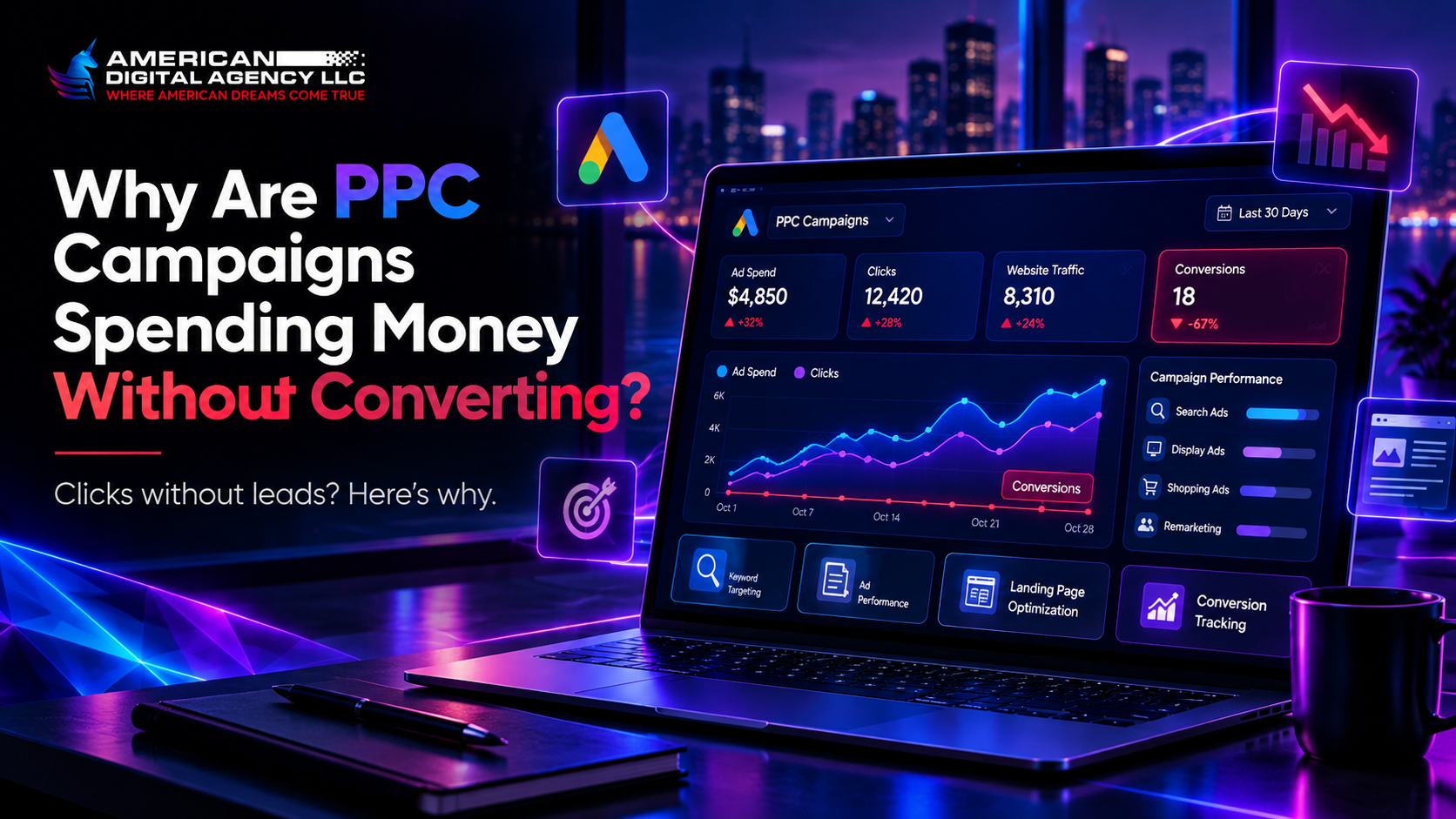
Running Google Ads can help a business reach people who are actively searching for its products or services. However, getting clicks does not automatically mean getting leads, inquiries, or sales. A campaign may attract visitors every day while the business struggles to generate meaningful results.
The problem is not always the advertising platform itself. Sometimes the keywords attract the wrong audience. In other cases, the ads make promises that the landing page does not fulfill, the website makes contacting the business difficult, or conversion tracking fails to record genuine customer actions. Understanding these issues is the first step toward improving campaign performance.
For businesses investing in paid advertising, identifying the reasons behind poor conversions can help make better marketing decisions. A well-managed campaign should focus not only on attracting relevant visitors but also on creating a clear path from the initial search to a meaningful business action.
What Does It Mean When a PPC Campaign Gets Clicks but No Conversions?
Pay-per-click advertising allows businesses to pay when users click on their advertisements. These clicks represent visits to a website, but they do not guarantee that visitors will become customers. A person may click an ad to research a service, compare providers, explore an offer, or find information without being ready to make a purchase.
A conversion occurs when a visitor completes an action that the business considers valuable. Depending on the business model, this could mean submitting a contact form, calling a company, requesting a consultation, booking an appointment, or completing a purchase. When a campaign generates clicks without these actions, the business needs to determine whether it is attracting the wrong visitors, presenting an ineffective offer, or failing to measure conversions correctly.
It is also important to distinguish between a campaign with genuinely poor results and one with incomplete tracking. A customer may call a business after visiting its website without that call being recorded in the advertising account. Before making major campaign changes, advertisers should verify that their conversion measurement is configured correctly.
Why Are PPC Campaigns Not Converting?
Several issues can prevent paid advertising from generating meaningful business results. These problems can occur independently or affect one another, making it important to examine the complete customer journey rather than focusing on clicks alone.
Are You Targeting the Wrong Keywords?
Keyword targeting determines which searches may trigger an advertisement. If the selected keywords are too broad or unrelated to the services being promoted, the campaign can attract people who are unlikely to become customers.
For example, a company offering professional website development may attract visitors searching for free website templates, website development tutorials, or entry-level learning resources if its targeting and search matching allow those queries. Such visitors may be interested in learning rather than hiring a professional provider.
Businesses should review the actual search terms associated with their ads and determine whether those searches reflect a genuine need for their services. Irrelevant terms can be excluded using appropriate negative keywords, while high-intent searches can receive more focused attention. The objective is not simply to increase traffic but to attract people whose needs match the business’s offering.
Does Your Advertisement Match the Customer’s Search?
Even when keyword targeting is relevant, the advertisement itself can create the wrong expectations. A headline that promises a particular service, benefit, or solution should accurately represent what visitors will find after clicking.
Imagine a business owner searching for professional PPC management. If the advertisement emphasizes campaign management but directs the visitor to a generic digital marketing page with little information about paid advertising, the experience may feel disconnected. The visitor might leave before making an inquiry because the page does not immediately answer the question that prompted the click.
Businesses should align their keywords, ad copy, and landing pages around the same customer need. The message should explain what the service provides, who it is intended for, and what the visitor can do next. Google Ads also recommends making advertisements and landing pages relevant to the user’s search and expected action.
Is Your Landing Page Making It Difficult to Take Action?
A landing page plays an important role in turning advertising traffic into potential customers. Visitors should be able to understand the offer, evaluate its relevance, and find a clear way to contact the business without unnecessary effort.
A page with confusing navigation, lengthy forms, distracting pop-ups, unclear service descriptions, or missing contact information can create friction. Even interested visitors may abandon the process if they cannot quickly determine the next step.
An effective landing page presents the most important information clearly, explains the service in language customers understand, and provides an appropriate call to action. Depending on the business, this might be a consultation request, a contact form, a phone number, or a product purchase button.
The page should also work properly on mobile devices. If buttons are difficult to tap, forms are awkward to complete, or important information is hidden on smaller screens, mobile visitors may struggle to convert. Businesses should test the complete experience on desktop and mobile rather than assuming that a page that looks good on a computer will work equally well on a phone.
Is Your Website Building Enough Trust?
Paid advertising can bring new visitors to a business, but it cannot automatically establish credibility. People considering an unfamiliar company may want to understand its experience, services, process, and approach before sharing their contact information or making a purchase.
A website that contains vague claims, incomplete service information, broken links, or inconsistent business details may leave visitors uncertain. The same can happen when a company makes broad promises without explaining how its services work.
Businesses can strengthen trust by presenting accurate service descriptions, genuine testimonials where available, relevant project examples, clear contact information, and a transparent explanation of the next steps. These elements should reflect the actual business rather than relying on exaggerated claims or fabricated results.
For service-based businesses, the landing page should answer practical questions before asking visitors to commit. People are more likely to consider an inquiry when they understand what the company does and how the service relates to their needs.
Could Your Conversion Tracking Be Incorrect?
Conversion tracking helps advertisers understand which interactions occur after someone engages with an advertisement. Without reliable measurement, a campaign may appear unsuccessful even when it is generating valuable business activity. Conversely, incorrect configuration can make performance appear better than it really is.
Common problems include forms that submit without triggering the expected tracking event, duplicate conversion events, incorrectly configured phone-call measurement, and outdated tags following website changes. Businesses may also count low-value interactions as conversions even when those actions do not indicate genuine buying intent.
The first step is to define what constitutes a meaningful conversion. A completed inquiry form, qualified consultation request, or confirmed purchase may be more useful than counting every page view or button interaction as a business outcome.
Next, test the conversion journey. Submit a test inquiry, verify the form confirmation, and check whether the appropriate event is recorded in the relevant analytics and advertising tools. Phone calls and other offline interactions may require separate measurement arrangements depending on how the business receives and processes leads.
Accurate tracking helps advertisers distinguish between a campaign that needs better targeting and one whose results are simply not being measured properly. Google identifies conversion tracking as an important consideration when diagnosing advertising delivery and optimization problems.
How Can Businesses Improve PPC Campaign Performance?
Improving a PPC campaign begins with understanding where the customer journey is breaking down. Making several unrelated changes at once can make it difficult to determine which adjustments actually helped.
Review Search Terms and Audience Relevance
Start by examining the searches that triggered advertisements. Identify queries that relate directly to the service, searches that suggest research rather than purchasing intent, and irrelevant queries that are unlikely to produce qualified leads.
Review location targeting as well, particularly if the business serves specific cities, regions, or service areas. A company may receive clicks from people who cannot realistically use its services if the campaign’s geographic settings do not reflect its operating area.
Use these findings to refine targeting, improve ad relevance, and exclude unsuitable traffic where appropriate. Avoid removing relevant search opportunities simply because they have not yet produced a conversion; consider the available data and the length of the customer’s decision process before making that judgment.
Improve the Connection Between Ads and Landing Pages
Every important advertisement should lead to a page that directly addresses the need expressed in the search. If an ad promotes a particular service, the destination should explain that service rather than forcing visitors to search through a general homepage.
Review the page headline, service description, supporting information, and call to action together. They should communicate a consistent message and help visitors understand what will happen if they submit an inquiry.
For businesses that need stronger landing pages, improvements to content structure, mobile usability, navigation, and form design can help remove obstacles in the conversion process. The goal is to make the next step clear without overwhelming visitors with unnecessary information.
Test Changes Methodically
Campaign optimization should be based on evidence rather than assumptions. Businesses can test different ad messages, landing-page headlines, calls to action, and form experiences to understand which approaches better serve their audience.
Each test should have a clear purpose and a measurable outcome. For example, a business might investigate whether a more specific landing-page headline improves qualified form submissions. Another test might examine whether simplifying a form helps visitors complete it.
Results should be interpreted in context. A change that increases clicks but attracts less relevant visitors may not improve business performance. Similarly, a campaign that produces fewer inquiries may still be valuable if those inquiries are more relevant and more likely to become customers.
Which PPC Metrics Should You Monitor?
Clicks and impressions help describe advertising activity, but they do not tell the whole story. Businesses should evaluate performance using metrics that connect advertising activity with meaningful customer actions.
Click-through rate can help indicate whether an advertisement attracts attention from people who see it. Conversion rate shows the proportion of measured interactions that result in a defined conversion, while cost per conversion helps advertisers understand the advertising expense associated with those measured actions.
Lead quality is equally important for businesses that rely on inquiries. A campaign may generate contact forms from people who are outside the service area, looking for something the company does not offer, or unlikely to become customers. Evaluating qualified leads alongside raw conversion counts provides a more useful picture of business value.
Advertisers should also consider what happens after a lead arrives. If inquiries are not followed up promptly, calls are missed, or the sales process is unclear, advertising may appear to underperform even when the campaign is attracting relevant prospects. Effective analysis considers the full process from the initial search to the final business outcome.
When Should You Consider Professional PPC Management?
Managing paid advertising involves more than writing advertisements and selecting keywords. It can require ongoing search-term analysis, audience targeting, conversion tracking, landing-page improvements, testing, and performance reporting.
A business may benefit from professional support when it cannot identify why campaigns are underperforming, struggles to measure qualified leads, or lacks the time and expertise to maintain its advertising accounts. An experienced provider should be able to explain the issues identified, recommend practical next steps, and report performance in terms that connect with the business’s objectives.
Before choosing a provider, businesses should look for clear communication, a defined management process, appropriate reporting, and realistic expectations. Be cautious of guarantees that promise specific results regardless of industry, competition, website quality, or campaign conditions.
American Digital Agency provides PPC marketing services for businesses looking to improve their paid advertising approach. Reviewing campaign targeting, advertisement relevance, conversion measurement, and the landing-page experience can help identify areas that may need attention.
How Can You Prevent PPC Problems From Returning?
PPC optimization should be an ongoing process rather than a one-time correction. Search behavior, business offerings, competition, website content, and campaign performance can change over time. Regular reviews help businesses identify emerging problems before they become persistent obstacles.
A consistent process includes reviewing search terms, checking conversion tracking, monitoring lead quality, testing important landing-page elements, and documenting campaign changes. Businesses should also ensure that their advertisements continue to represent the services they currently provide.
Communication between marketing and sales teams can improve the process further. Feedback from people who handle inquiries can reveal whether leads are relevant, what questions prospects repeatedly ask, and where potential customers lose interest. These insights can inform both advertising messages and website improvements.
The most useful optimization decisions come from combining reliable performance data with a clear understanding of customer needs. Instead of chasing clicks alone, businesses should focus on attracting relevant visitors, helping them make informed decisions, and making it easy for them to take the next step.
Conclusion
When PPC campaigns spend money without generating conversions, the answer is not always to increase the budget or replace the entire advertising strategy. The underlying problem may involve irrelevant searches, disconnected ad messaging, a confusing landing page, weak trust signals, or inaccurate conversion tracking.
A structured review helps businesses identify these issues and prioritize changes based on evidence. By aligning keywords, advertisements, landing pages, and conversion measurement, companies can make more informed decisions about their paid advertising and improve the experience offered to potential customers.
For businesses that need help evaluating their campaigns, American Digital Agency’s PPC marketing services provide a relevant starting point for discussing advertising goals, campaign challenges, and possible improvements.
FAQs:
Why are my PPC campaigns getting clicks but no leads?
PPC campaigns may receive clicks without generating leads because of irrelevant keywords, poorly targeted ads, confusing landing pages, or incorrect conversion tracking.
How can I improve my PPC campaign conversion rate?
Improve keyword targeting, match ads with relevant landing pages, simplify contact forms, and verify that conversion tracking works correctly.
Can wrong keyword targeting waste my PPC budget?
Yes. Irrelevant search terms can attract visitors who are unlikely to become customers. Reviewing search terms and adding appropriate negative keywords can help reduce wasted spend.
Why is my Google Ads conversion tracking not working?
Common causes include incorrectly configured tracking tags, form-submission errors, duplicate conversion events, and problems with call tracking.
Should I increase my Google Ads budget if I am not getting conversions?
Not immediately. First, review targeting, landing-page experience, conversion tracking, and lead quality to identify why your campaign is underperforming.