Off-the-shelf software works fine until the day your business outgrows the box it came in. Maybe your team is exporting spreadsheets out of three different tools just to run one weekly report. Maybe a monthly subscription tool keeps charging more every time you add a seat, while still missing the one workflow your operation actually runs on. That is usually the moment founders and operations leaders start looking into custom web application development.
Partnering with an experienced web application development company lets you replace duct-taped software with a single browser-based platform built around how your business actually operates. Before you write a single requirement or talk to a vendor, however, it helps to understand what separates a custom web app from a standard website, what drives project scope, and how to plan a build that pays for itself.
What Is Custom Web Application Development?
A standard marketing website exists to share information and capture leads. A custom web application is interactive software that runs inside a web browser and performs real operational work for your customers or internal team.
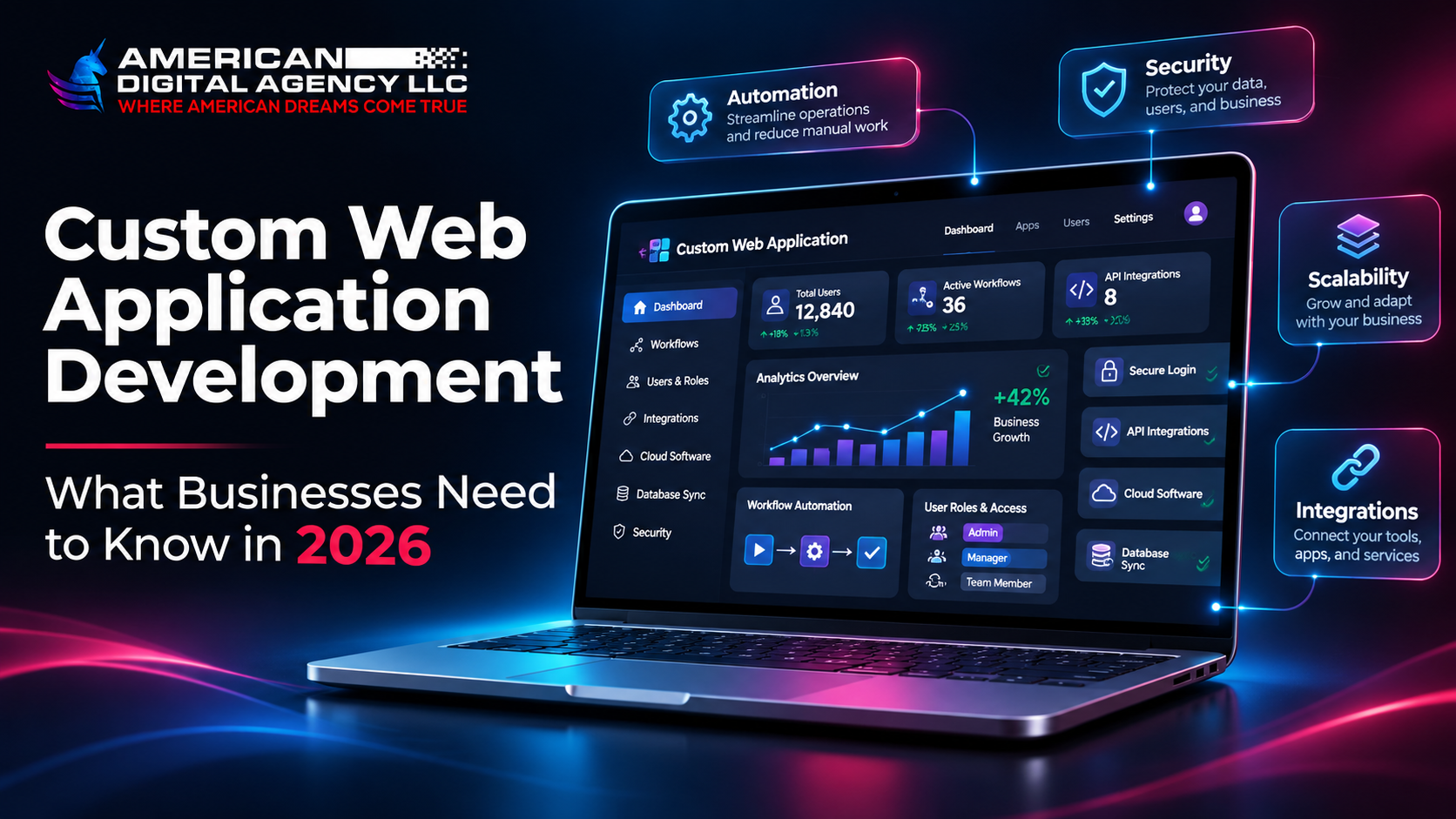
Think of customer portals, booking engines with live inventory, multi-vendor marketplaces, healthcare scheduling dashboards, or internal logistics trackers. Users log in, submit data, trigger automated workflows, and interact with live databases in real time. Because the software runs in the browser, your team and customers can access it from any desktop, tablet, or phone without downloading anything from an app store.
Custom Web App vs. Off-the-Shelf SaaS: Which One Makes Sense?
Not every problem requires custom engineering. Buying an existing SaaS subscription is often the fastest way to test a brand-new workflow. Custom development becomes the smarter long-term move when off-the-shelf tools start slowing your business down:
| Factor | Off-the-Shelf SaaS | Custom Web Application |
| Workflow Fit | Forces your team to adapt to the vendor’s rigid templates. | Built 100% around your exact business rules and approval steps. |
| Long-Term Ownership | Rented software subject to annual price hikes and feature limits. | You own the source code, database, and intellectual property outright. |
| Integrations | Often requires third-party connectors that break during updates. | Connects directly via clean APIs to your ERP, CRM, and payment tools. |
| Competitive Advantage | Every competitor can buy the exact same tool tomorrow. | Proprietary workflows and customer portals become a defensible moat. |
| Scalability | Per-user licensing penalizes you as your team or customer base grows. | Architecture scales with your user volume without per-seat penalties. |
If your team spends hours every week working around software limitations—or if your software is the product you sell to clients—building custom eliminates the ceiling. For example, many online retailers eventually replace scattered plugins with a custom CRM for an e-commerce business so order history, support tickets, and customer segments live in one unified system.
What Drives the Scope and Investment of a Custom Web App?
Every business asks what goes into planning a custom build. Because no two applications share the exact same logic, total effort depends on five core scope drivers rather than a one-size-fits-all formula:
1. User Roles and Workflow Complexity
An internal dashboard used by ten staff members requires far fewer permission layers than a multi-sided marketplace with buyers, sellers, and administrators. The more user roles, approval chains, and conditional rules your platform needs, the deeper the back-end engineering required.
2. UI/UX Architecture and Custom Dashboards
Software only delivers ROI if people actually enjoy using it. Working with a dedicated UI/UX design team to map user journeys, interactive wireframes, and clean data visualizations prevents confusion and cuts employee training time in half.
3. Third-Party API and Legacy System Integrations
Modern web apps rarely live in isolation. Syncing your platform with payment gateways (like Stripe), accounting software, shipping carriers, CRM databases, or existing ERP tools requires careful API mapping, error handling, and real-time data validation.
4. Security, Compliance, and Data Privacy
Applications handling financial transactions, customer records, or healthcare information require strict encryption, role-based access control, audit logs, and secure authentication from day one. Building security into the core architecture is far safer and cleaner than patching it on after launch.
5. AI Automation and Real-Time Reporting
In 2026, many businesses embed intelligent automation directly into their web applications—such as automated document processing, predictive lead scoring, smart search, or natural-language reporting assistants—to reduce manual administrative hours.
Our Step-by-Step Web Application Development Process
At American Digital Agency, our website development services and web app engineering follow a transparent, milestone-driven process so you always know what is being built and why:
- Discovery & Technical Scoping: We map your user workflows, prioritize must-have MVP features, and define the database and cloud architecture before writing code.
- Wireframing & UI/UX Prototyping: You test clickable screens early so navigation and user flows are validated before full engineering begins.
- Agile Full-Stack Engineering: Front-end and back-end developers build in short, reviewable sprints with clean, well-documented code.
- Quality Assurance & Security Testing: Every form, API connection, mobile breakpoint, and edge case is stress-tested prior to deployment.
- Launch, Handoff & Ongoing Support: You receive full ownership of your codebase and cloud environment, backed by post-launch monitoring and feature updates as your user base grows.
How to Keep Your Project Lean and High-ROI
You do not need to build every feature on your wishlist in version one. The smartest companies launch a focused Minimum Viable Product (MVP) that solves their single biggest operational bottleneck first, gathers real user feedback, and rolls out phase-two enhancements once the core platform is already saving time or generating revenue.
Ready to turn a manual workflow or software idea into a fast, scalable web platform? Request a custom project scope with American Digital Agency’s USA-based engineering team for a clear technical roadmap tailored to your business goals.
Frequently Asked Questions (FAQs)
When does custom web app development beat off-the-shelf SaaS?
When your team wastes hours exporting spreadsheets between disconnected tools, or when rigid software forces you to bend your workflow around someone else’s rules.
Can one custom web app replace multiple software subscriptions?
Yes. A single custom platform can unite your client portal, internal approvals, inventory, and reporting under one login eliminating duplicate data entry and per-seat licensing limits.
How do you prevent a custom build from dragging on forever?
We start with a lean Minimum Viable Product (MVP) that solves your biggest operational bottleneck first, shipping in short, reviewable sprints before adding phase-two features.
Who owns the source code and data after launch?
You do, 100%. American Digital Agency hands over full ownership of your source code, database, cloud accounts, and documentation with zero vendor lock-in.
Will a custom web app sync with our existing CRM or accounting tools?
Yes. We build clean REST and GraphQL API integrations that connect seamlessly with Salesforce, HubSpot, Shopify, Stripe, QuickBooks, and legacy internal databases.
What happens as our user volume and data grow?
Because we engineer on scalable cloud architecture from day one, your web app handles traffic spikes and new user roles smoothly—backed by ongoing monitoring and post-launch support.