
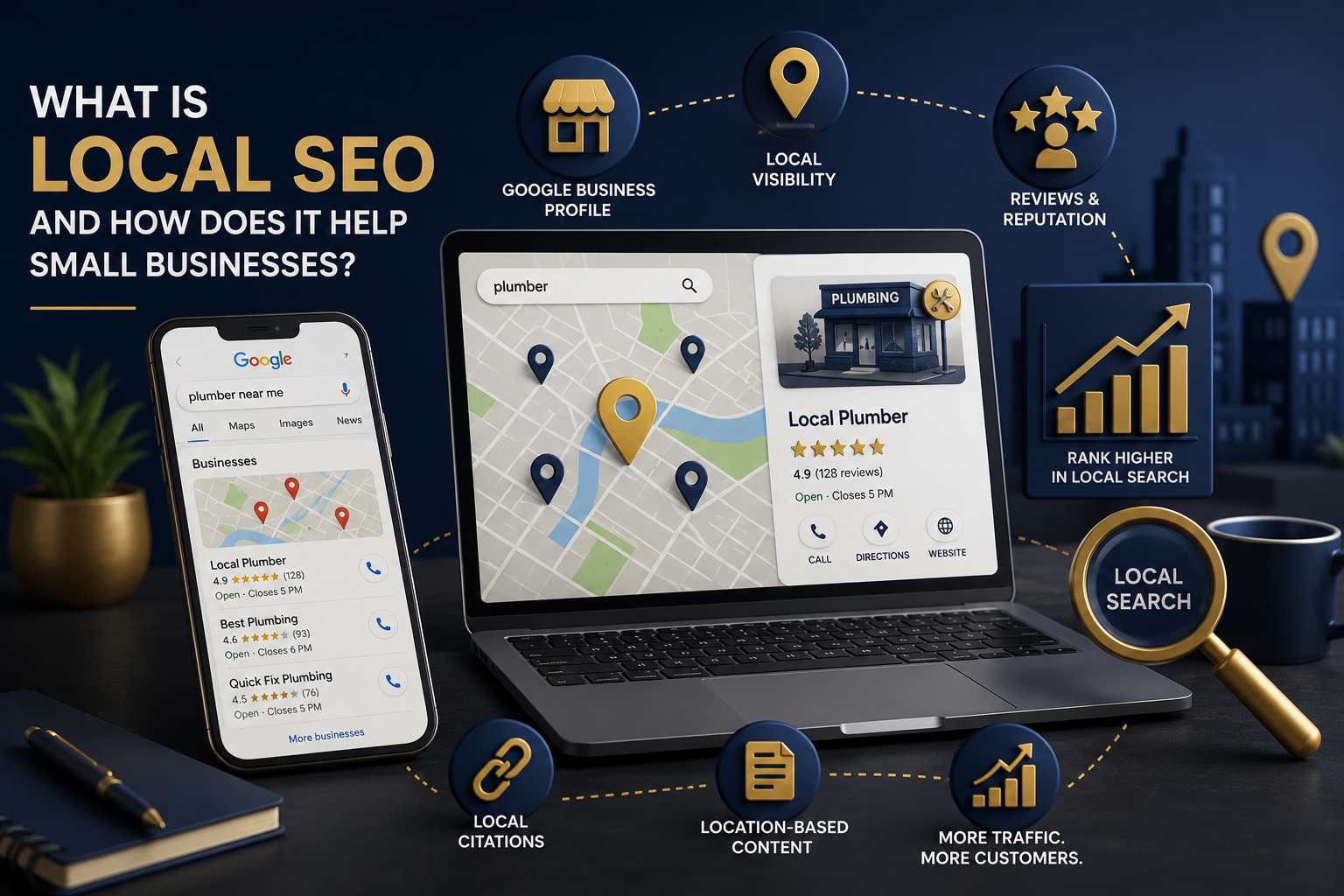
Search “plumber” on a phone in Cleveland and Google barely cares about the best plumber in the country. It cares about the closest decent one with a few good reviews. That gap, between ranking globally and ranking down the street, is basically the whole story of local SEO.
Most owners already grasp what is SEO at a basic level. Rank on Google, catch some clicks, sell things. Local search bends that idea into something smaller and, oddly, more forgiving. A one-chair barbershop can genuinely win. It just has to win a very specific fight, in a very specific radius, against maybe eight other shops instead of eight million websites scattered across the planet.
Why a Local SEO Strategy Beats Chasing Big Keywords
Going after “best coffee” is a fantasy for a cafe in Boise. Starbucks owns that phrase. Roasting blogs own whatever is left.
A local seo strategy throws that ambition out and picks a fight worth having instead. “Espresso downtown Boise.” “Cold brew near the university.” Ugly little phrases. Also the ones that ring the register.
One roaster swapped a year of generic “how coffee is made” posts for four plain pages built around actual neighborhood searches. Raw traffic dropped. Sales went up. The people showing up afterward were three blocks away and thirsty, not hobbyists reading in another timezone at midnight.
The Google Business Profile Is Where Most Wins Hide
Forget the fancy stuff for a second. Before a single blog post, before any redesign, comes the profile.
A Google Business Profile is the free listing that shows hours, photos, reviews, and a map pin. Fill it out halfway and Google shrugs. Fill it out completely, keep it current, answer the occasional weird question, post an update now and then, and Google starts paying real attention.
The parts that move the needle are almost boring:
- Hours that are correct, holidays included, because nothing torches trust faster than a locked door at 2pm on a Tuesday the listing swore was open.
- One primary category, chosen with care. A taqueria filed under “restaurant” competes with the entire city. Filed under “Mexican restaurant,” it competes with the other taquerias, which is a fight it can actually win.
- Photos shot this year on a real phone. Not a stock image of somebody else’s latte.
Google Maps SEO and the Fight for Three Slots
Glance above the blue links on almost any local search. There is a small map, and three businesses stacked underneath it. That block has a name, the local pack, and google maps seo is the whole scramble to climb into it.
Google has been unusually blunt about how those three get picked. Relevance, distance, prominence. Whether the business matches the search, how close it physically sits, and how well known it happens to be. Distance is mostly the luck of an address. The other two get earned the hard way.
Which explains how a scrappy garage two miles out can bump a chain parked right downtown. Reviews and reputation tip the scale, and reputation is something a stubborn owner can build with no marketing department at all.
What Really Drives Local Search Ranking
Most of what gets sold as a ranking secret is noise. Only a handful of things actually move local search ranking, and none of it photographs well.
- Name, address, phone. Identical in every single place. One ancient listing with a former suite number can quietly drag things down for months, and nobody ever thinks to look.
- Reviews, fresh ones especially. A steady drip of new ones reads to Google as a business that is still open and still worth trusting. Fifty five-star reviews that all dried up in 2021 read as “something went wrong here.”
- Anything truly local on the site. A guide to parking near the shop. A write-up of the neighborhood street fair. Small stuff the competition is far too lazy to bother making.
- Links from around town. A chamber of commerce page, a mention in the local paper, the youth soccer team whose jerseys happen to carry the shop logo.
American Digital Agency once pushed a client into the local pack by fixing nothing but an address that read “Ste 200” on one directory and “Suite 200” on another. A few weeks later, page two turned into the map. No fresh content. Just a comma’s worth of consistency finally lining up.
Here is what makes the whole effort worth it for a small operation. Money matters less than plain accuracy. A tidy profile, honest reviews, and a couple of pages written for actual neighbors will out-rank a national brand for the searches happening inside one zip code, again and again.
The internet mostly rewards scale. Local search, for once, quietly rewards the shop that simply does the boring things right.
Frequently Asked Questions
How fast does local SEO usually work?
Quicker than national SEO. Profile fixes and review growth can show up in a few weeks, with steadier gains landing over two to three months.
Is a website necessary, or does a Google Business Profile do the job alone?
A profile can rank on its own, but a small website adds trust and prominence, and the pair consistently beats a lone profile.
Do reviews genuinely change rankings?
Yes. Count, rating, and recency all feed the prominence signal Google names among its ranking factors, which is why recent reviews carry more weight than old ones.
Can a business rank somewhere it has no physical address?
Hard, though not impossible. A service-area business leans on reviews, local content, and nearby links to offset the distance Google would otherwise count against it.