
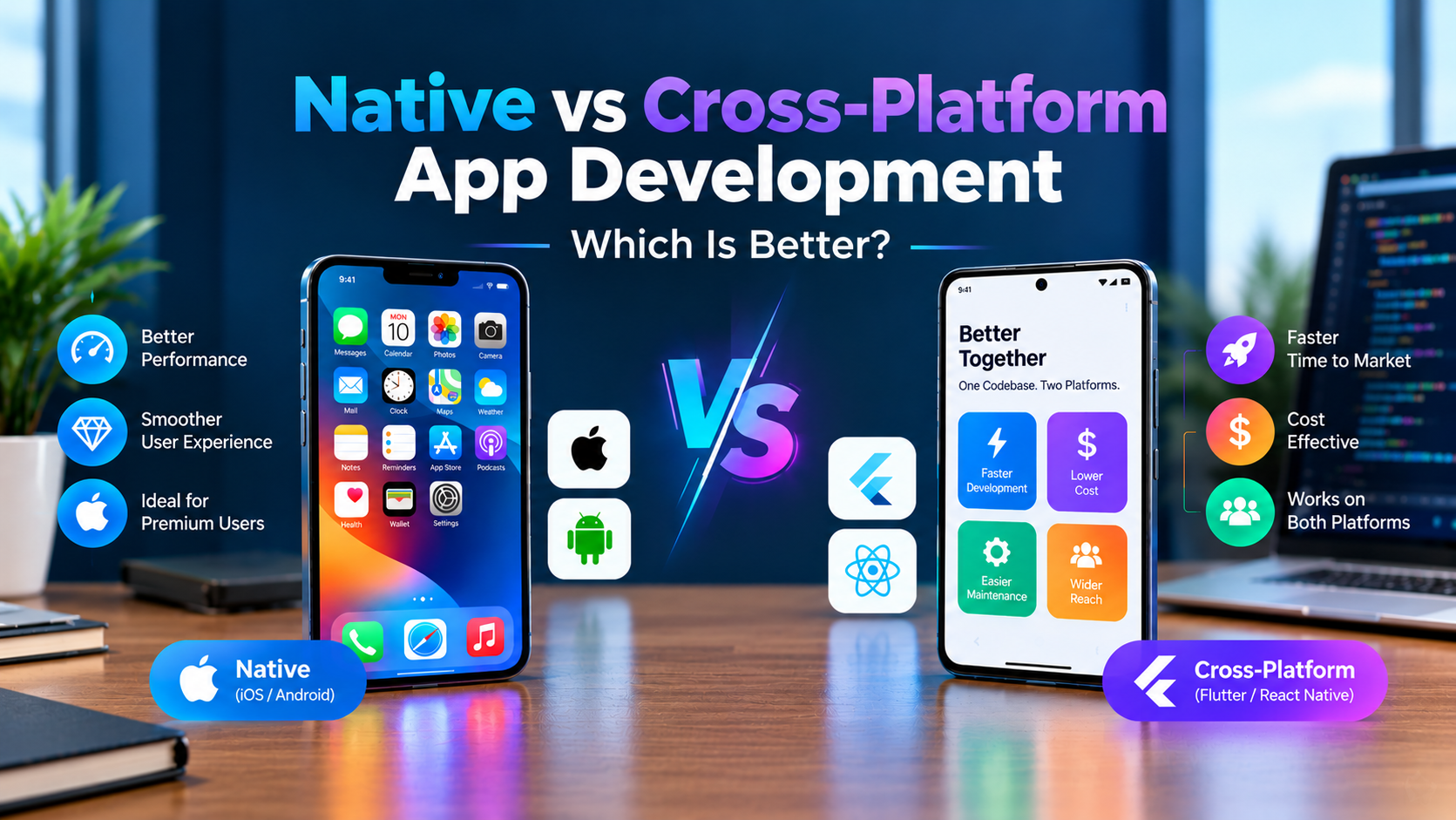
Two roads. Same destination.
Build one app for each platform, tuned to the metal. Or build once and run everywhere. That is the whole native versus cross-platform fight, minus the marketing noise.
Every app development company has a favorite, usually the one that happens to fit its own team. Ignore the sales angle. The right choice depends on the app, the budget, and how much the last ten percent of polish actually matters.
Here is the plain version, without the jargon tax.
No universal winner exists here. Anybody who claims otherwise is selling something.
So the honest move is to match the tool to the job, not the other way around.
iOS App Development, Where Polish Pays
iOS app development means writing natively for Apple, in Swift, against Apple’s own tools and frameworks.
The payoff is smoothness. Native iOS apps feel fast because nothing sits between the code and the phone. Animations glide. Gestures land. The thing simply feels expensive.
There is a money angle too. iPhone users spend more, on average, than Android users worldwide. A lot more, in some categories.
So apps chasing paying customers often launch on iOS first. Not loyalty. Just math.
The downside is a narrower reach. Fewer devices in fewer hands, especially outside wealthy markets. Premium, not popular.
Quick pointer: if the audience skews toward higher spenders or the US market, iOS first is rarely the wrong bet.
Android App Development, Where the Numbers Live
Android app development runs on Kotlin now, mostly, against Google’s toolkit and build system.
The pull here is reach. Android owns the majority of phones on the planet by a wide margin, especially outside North America. Want scale, or emerging markets, or sheer headcount? Android is where the crowd is, and the crowd is enormous.
The trade is fragmentation. Thousands of device models, screen sizes, and Android versions loose in the wild. Testing drags. Something always looks slightly off on some cheap phone nobody at the office happens to own, and that stray bug can quietly cost real installs.
Worth knowing: Android testing eats more hours than teams expect. Budget for the device zoo, not just the code.
Another pointer: more phones does not mean more money. Reach and revenue are different games entirely.
Cross-Platform Apps, One Codebase for Both Stores
Then comes the tempting middle. Write once, ship to both.
Cross-platform apps use tools like Flutter or React Native to build a single codebase that runs on iOS and Android at the same time. One team. One project. Roughly one budget instead of two.
For plenty of apps, that is the smart move. A content app. A store. A booking tool. An internal dashboard. Things that never push the hardware hard.
The savings are not just money. One codebase means one bug fix, not two. One update, not two. That adds up fast over years.
The catch shows up at the edges. Heavy graphics. Deep device features. Buttery, frame-perfect animation. Cross-platform handles most of it now, and better every year, but native still wins the last stretch when that stretch actually matters.
Quick pointer: prototype cross-platform first. If it feels good enough, the savings are real. If it stutters, go native for that one piece.
How to Actually Choose a Mobile App Development Path
Skip the religious war. Mobile app development choices come down to a handful of blunt questions:
- One platform or both? Both on a tight budget points hard toward cross-platform.
- How demanding is the app? Games and AR lean native. Almost everything else does not.
- Who is the audience, and where? Payers and the US lean iOS. Global scale leans Android.
- How fast does it need to ship? Cross-platform launches quicker on a single team.
Answer those honestly and the path tends to pick itself.
Worth knowing: the platform choice is reversible. Plenty of apps start one way and switch once the numbers come in. Nothing here is permanent.
American Digital Agency has steered plenty of startups toward cross-platform for a first launch, then rebuilt native later once the idea proved itself and the budget grew. Ship, learn, then upgrade. That order burns far less cash than chasing perfection on day one.
Quick pointer: a launched cross-platform app beats a flawless native app still stuck in development. Shipping teaches more than planning ever will.
So. Which one?
Native when polish or raw power decides the outcome. Cross-platform when speed and budget do. Both, eventually, if the app earns the second build.
The wrong move is choosing on principle, or on whatever a developer happened to learn first. Choose on the app sitting in front of the team, and the whole question stops being complicated.
Budget, audience, and how hard the app pushes the phone. Three answers. One decision. That is really all this ever comes down to.
Frequently Asked Questions
Is native or cross-platform better?
Native wins on performance and polish; cross-platform on speed and cost. The right pick depends on the app’s demands and the available budget.
Is cross-platform development actually cheaper?
Usually, since one codebase serves both platforms instead of two separate builds. Complex, high-performance apps can narrow or even erase that saving.
Should an app launch on iOS or Android first?
iOS often suits apps targeting higher spenders or the US market, while Android fits global reach. Audience location decides more than almost anything.
Can a cross-platform app feel as good as native?
For most apps, yes, and the gap keeps shrinking. Graphics-heavy or hardware-deep apps are where native still holds a clear edge.