
Think about the last time you closed a browser tab out of sheer frustration. Maybe the checkout button didn’t work, the text jumped around while loading, or it just sat there spinning. That broken experience is exactly what happens when web development goes wrong.
So, what is website development? Strip away the confusing jargon, and it is simply the actual engineering that makes a website work. While web design is about how a site looks, development is the code that breathes life into those mockups. It transforms flat images into responsive, fast-loading, and secure digital tools that actually help run a business.
To understand how it all fits together, you have to look under the hood at the different roles and systems developers use every day.
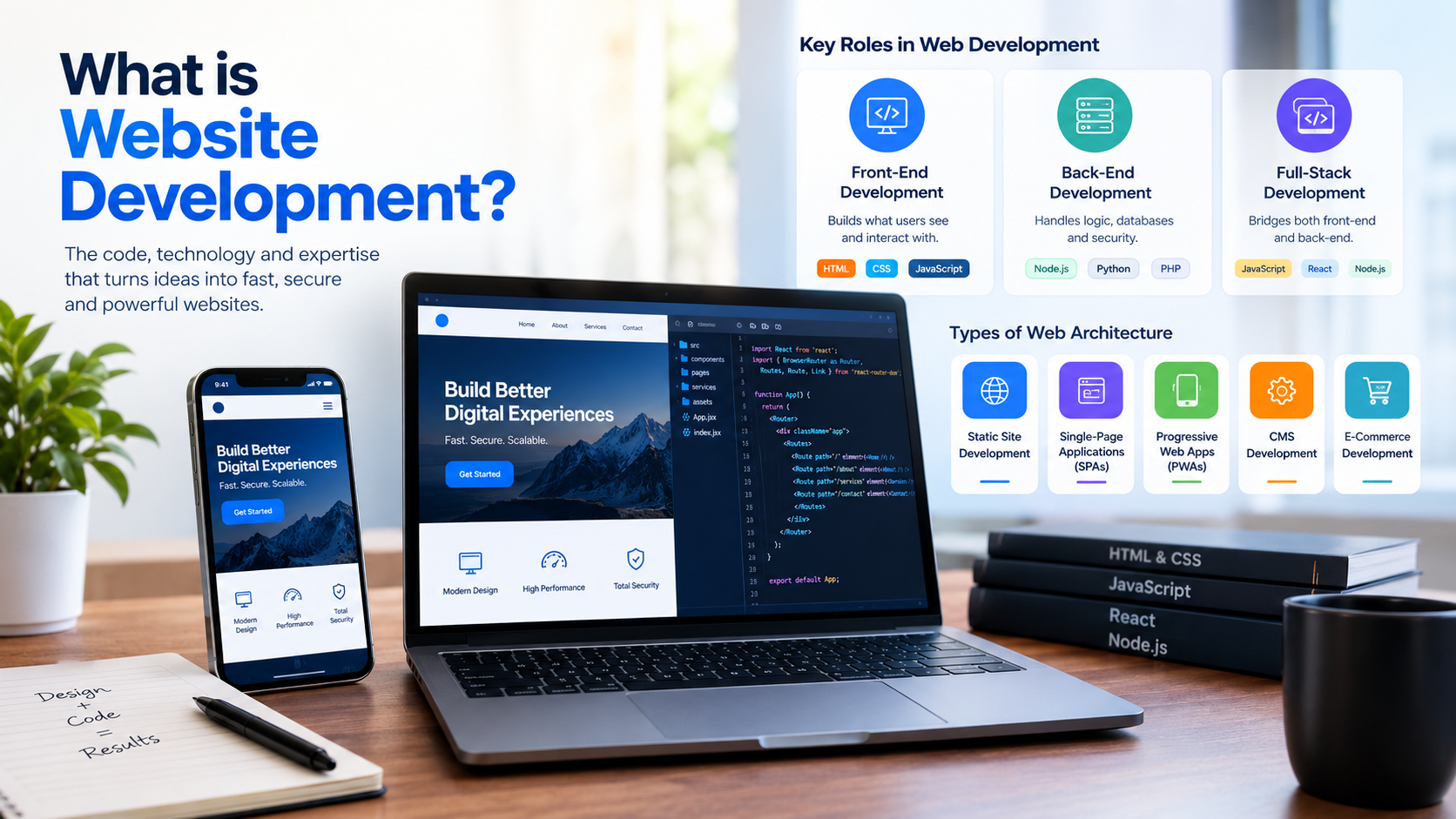
Front-End Development
Front-end development is everything a user interacts with directly. If you can see it, click it, hover over it, or expand it on your screen, a front-end developer built it. Often called client-side engineering, it requires translating design files into clean code using HTML to layout the structure, CSS to handle styles, and JavaScript to power interactive elements. Today, teams rarely build from scratch; they use heavy-hitting JavaScript frameworks like React, Vue, or Angular to ensure a web app transitions smoothly whether a customer opens it on an iPhone or a 27-inch desktop monitor.
Back-End Development
If the front-end is the sleek dashboard of a car, back-end development is the engine block. You don’t see it while driving, but without it, you aren’t moving an inch. Operating quietly on the server-side, back-end development handles the business logic, security protocols, database management, and user authentication. Back-end engineers build the data pipelines using languages like Node.js, Python, PHP, or Ruby. Every time someone submits a lead form, logs into an account, or processes a payment, the back-end securely validates, stores, and routes that information across databases like SQL or MongoDB.
Full-Stack Development
Full-stack development bridges both sides of the coin. A full-stack developer is fluent in both client-side interfaces and server-side databases. They can draft a responsive UI framework in the morning and configure the server infrastructure or API integrations by the afternoon. For expanding companies, having full-stack expertise on hand is a massive advantage because it minimizes communication bottlenecks and ensures the user interface doesn’t make promises that the database architecture can’t actually keep.
Types of Web Architecture
Before typing out a single line of code, software teams have to select a foundational blueprint. The architecture you choose determines how data travels between the host server and the user’s browser, which dictates your long-term hosting costs and loading speeds.
Static Site Development
Static site development is a modern take on the traditional web. Instead of waiting for a server to assemble a page every time a user clicks a link, a static site pre-builds every page into lightweight HTML, CSS, and JavaScript files ahead of time. When a visitor lands on the site, the pages serve instantly. By utilizing modern frameworks like Next.js or Gatsby coupled with a headless CMS, businesses get lightning-fast speeds, minimal server costs, and tight security because there is no direct database for hackers to exploit. It is perfect for marketing sites, corporate brochures, and landing pages.
Single-Page Applications (SPAs)
Single-Page Applications (SPAs) are designed to make websites feel exactly like desktop software. Instead of reloading the entire screen every time you click a menu item, an SPA loads a single shell page once. As you navigate around, the application dynamically swaps out only the specific text or images requested from the server. Built heavily on JavaScript engines like React, SPAs eliminate that annoying “white screen flash” between page clicks, making them the industry standard for SaaS platforms, custom dashboards, and web-based software apps.
Progressive Web Apps (PWAs)
Progressive Web Apps (PWAs) break down the wall between mobile websites and native phone applications. A PWA is essentially a highly optimized website that acts like an app; users can install it directly onto their phone’s home screen without dealing with the Apple or Google app stores. Because they use smart background scripts called service workers, PWAs can load instantly, operate smoothly in offline mode, and even send push notifications. For companies looking to build a mobile presence without paying for two separate native app builds, this framework is a highly cost-effective alternative.
CMS Development
CMS development centers on building sites using Content Management Systems like WordPress, Shopify, or Webflow. The primary goal here is utility: decoupling the underlying web architecture from daily publishing tasks. A properly developed CMS allows internal marketing teams, editors, and owners to update copy, launch blogs, and tweak product listings instantly without needing a developer to deploy code updates. Professional development in this space focuses on writing clean, custom themes and secure code environments so the platform stays nimble instead of getting bogged down by clunky plugins.
E-Commerce Development
E-Commerce development is the technical construction of high-performance digital storefronts. This discipline requires an entirely different level of engineering rigor because you are dealing with real-time transactional variables. Developers have to seamlessly sync inventory databases, map out complex shipping calculators, integrate automated tax compliance systems, and connect secure payment gateways like Stripe. The ultimate metric of success in e-commerce engineering is reducing checkout friction; every extra millisecond a page takes to load directly increases your cart abandonment rate.
Conclusion
At the end of the day, your website shouldn’t just sit there looking pretty it has to solve a tangible business problem. Choosing the right architecture, whether that means the instant load times of a static build, the seamless interactivity of a single-page app, or a heavy-duty e-commerce storefront, lays the groundwork for your organic traffic and conversion rates. Building a footprint that scales requires moving away from fragile, generic templates and building intentional code. If you are ready to eliminate technical headaches and build a fast, high-converting asset that operates flawlessly, the team at american digital agency is ready to turn your concept into a digital reality that lasts.
Frequently Ask Question’s
What is the difference between web design and web development?
Web design covers the visual layout, color schemes, and user experience. Web development builds the actual code like HTML, CSS, and JavaScript—to make that design function as a live website.
Do I need a custom website or a template-based CMS?
Templates work well for simple brochures and basic landing pages. Custom builds are necessary if your business requires unique operational workflows, advanced data security, or fast speeds under heavy traffic.
Why separate the frontend from the backend?
Dividing the user interface from the database increases site speed and security. It allows you to update how the website looks without risking or breaking the core data logic running behind the scenes.
How does website development affect my business’s SEO?
Google ranks websites based on user experience. Clean backend code ensures fast loading times and mobile responsiveness; bloated code will lower your search rankings regardless of your content.
What is a Progressive Web App (PWA)?
A PWA is a website optimized to act exactly like a mobile application. Users install it directly onto their phone screens without using an app store, saving the cost of native app builds.